Pause, run, edit or delete an automation
You manage automations from the Automations tab in the Data Library: click a row to open its detail panel, or use the row's three-dot menu (⋯). From there you can suspend or resume an automation, run it now, edit it, see its activity and delete it. You need the Monitor orchestration status permission to see the list, and Create/manage orchestration flows to change automations.
Read the automation list
The Automations tab shows all automations in the current project.
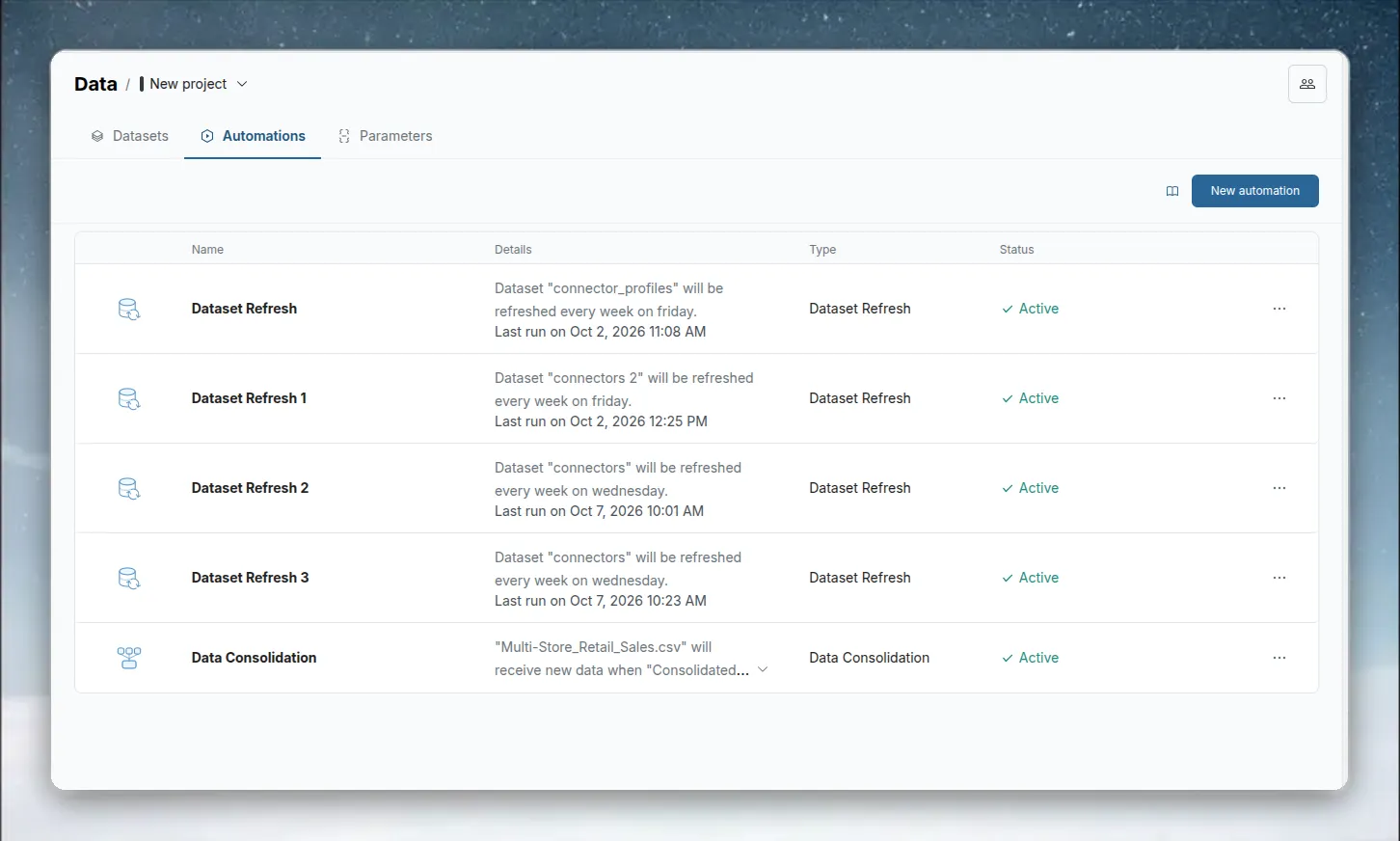
| Column | What it shows |
|---|---|
| Name | Automation name and description (if set) |
| Details | One-line summary of what the automation does |
| Type | Dataset Refresh, File Collection, Data Consolidation, Scheduled Export or Messaging |
| Status | Active, Suspended, Error, Needs your input or Files not added |
While an automation is working, its row also shows a live status pill. Click any row to open the detail panel on the right.
When a project has 8 or more automations, a Search automations box appears above the list. Type part of a name to filter it. If nothing matches, the list shows "No results found for your search".
If your role in the project doesn't include viewing automations, the tab says "You don't have access to Automations" and "Your role in this project doesn't include viewing automations. Ask a Project Admin for access." If there are none and you can't create them, it says "No automations yet" and "Ask a Project Admin to set one up."
What each automation status means
| Status | Icon | Meaning |
|---|---|---|
| Active | Green check | Runs normally on its schedule or trigger |
| Suspended | Grey pause | Paused. It doesn't run on its schedule, and you can't run it by hand until you resume it |
| Error | Red warning | The last run failed, or a dataset, View or folder it uses was deleted. Check Last run result |
| Needs your input | Amber question mark | Data Consolidation only: a PDF or image batch couldn't be matched to the destination's recipe and is waiting on someone |
| Files not added | Amber warning | Data Consolidation only: the automation works, but one or more files didn't go in or were kept separate. Open the source folder to fix them |
An Error takes priority over Needs your input and Files not added.
Live run status
While a run is under way, the row shows a pill with what it is doing. The same pill shows on the folder or dataset rows in the Data Library that the automation works on. Hover over it to see the automation's details.
| Pill | Meaning |
|---|---|
| Queued | Waiting to start |
| Analysing | Checking new files against the destination (Data Consolidation) |
| Running | The run is in progress, or files are being processed |
| Needs review | A file's columns don't match the destination, so it needs review |
| Finished | The run has finished |
| Failed | The last run failed, or a file could not be appended |
Open the detail panel
Click an automation row. The panel slides open on the right. Its header has Edit, Run now and Delete.
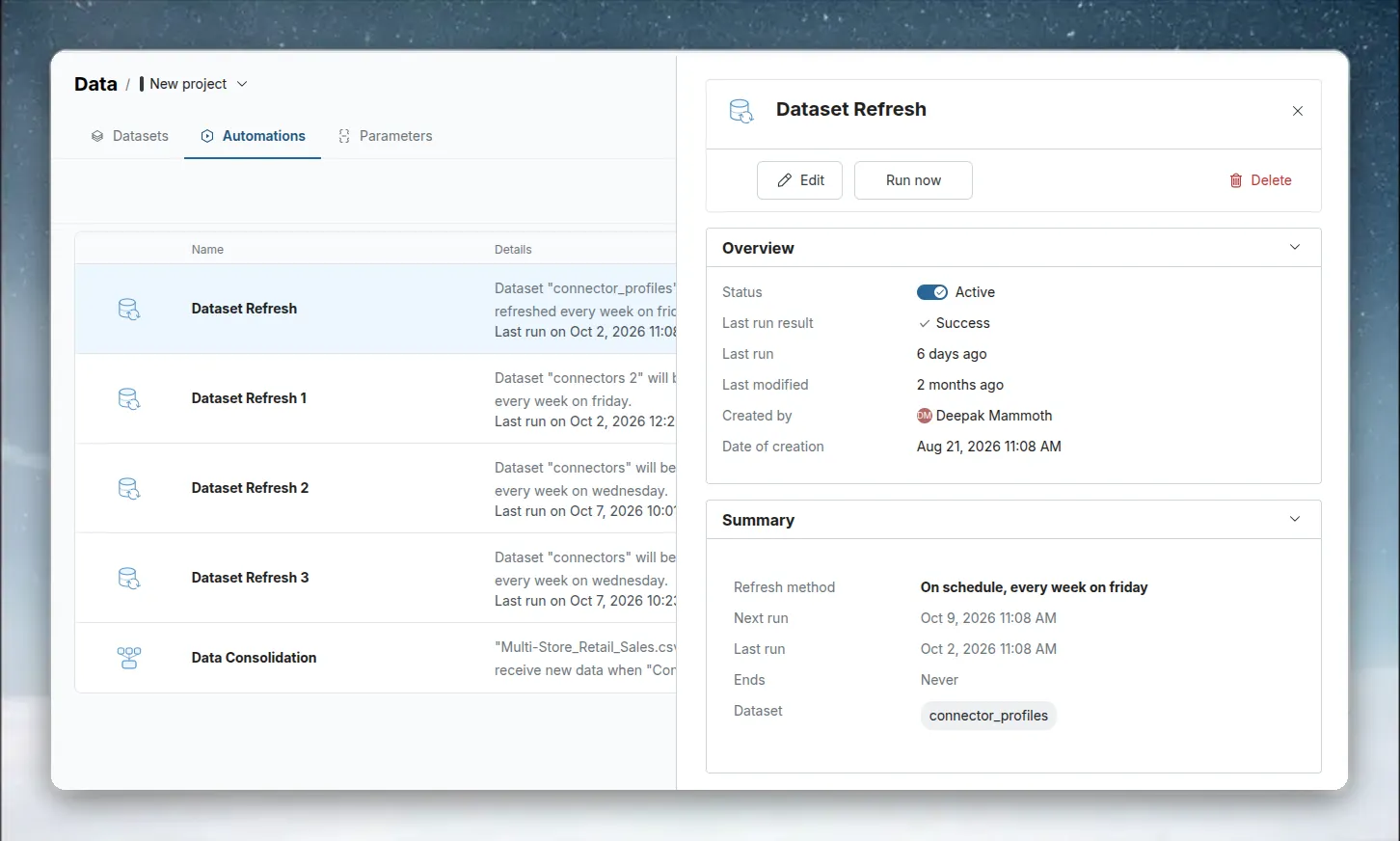
Overview
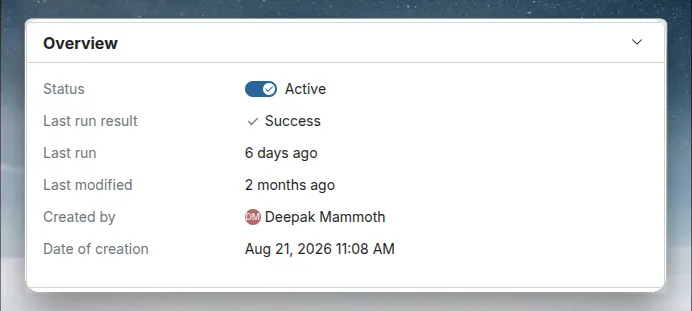
| Field | What it shows |
|---|---|
| Status | Toggle to activate or suspend the automation. Shows Active or Suspended. During a trial it also shows a Trial pill |
| Last run result | Success, the reason the last run failed, or Not run yet |
| Last run | When it last ran (hover for the exact time) |
| Last updated by | Who last edited it |
| Last modified | When it was last edited |
| Created by | Who created it |
| Date of creation | When it was created |
A Dataset Refresh suspended because your trial ended shows Refresh Manually next to its status, with the tooltip "This automation got suspended after trial. Refresh manually by retrieving latest data." It opens the dataset's settings so you can pull the latest data by hand. See Refresh a dataset by hand after a trial ends.
Summary
The Summary shows the settings for the automation's type: schedule, datasets, exports, recipients and so on. It includes Next run, Last run and Ends (the end date, or "Never") for scheduled types. For a Data Consolidation it names the source folder, the name pattern (if any) and the destination dataset.
See which files a Data Consolidation took in
A Data Consolidation automation also has a History section. It lists the last 20 runs, newest first. Files that arrive within 10 minutes of each other count as one run.
| Part | What it shows |
|---|---|
| When | When the run started (hover for the exact time) |
| How the files arrived | Uploaded file (or "3 uploaded files"), Moved in (a dataset moved into the folder, or "3 moved in"), or Added on request (a file added with Add anyway) |
| Result | Added or All 3 added, 2 of 3 added, Nothing added, or In progress. Duplicates don't count toward the total |
| Rows | The rows that went in, for example +1,250 rows |
Click Files on a run to see each file and how it went, for example "Added to Sales · 1,250 rows" or "Its columns don't match Sales". Click Hide files to close it. The first run with a problem opens on its files when you open the panel. A file skipped as a duplicate has Add anyway next to it.
Before any file arrives, History says "No files yet. Each file this automation takes in shows here, with how it went." If it can't load, it says "Couldn't load the history." For what each file reason means, see Fix a file that didn't go into the dataset.
Suspend or resume an automation
Suspending stops an automation from running without deleting it.
| To | Do one of these |
|---|---|
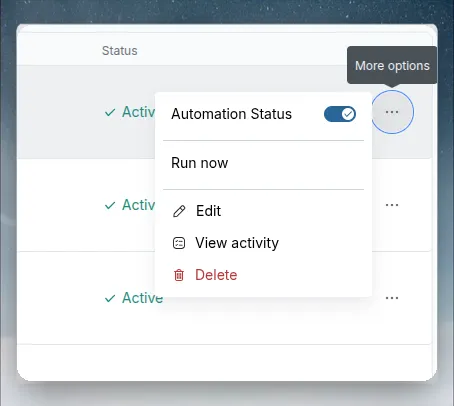
| Suspend | Toggle Status off in the detail panel. Or click ⋯ on the row and toggle Automation Status off. Or click Suspend in the edit window |
| Resume | Toggle Status back on in the detail panel. Or toggle Automation Status on in the ⋯ menu. Or click Resume in the edit window |
A suspended automation shows Suspended and doesn't run. A suspended Data Consolidation doesn't take files added to its folder. When you resume, the status returns to Active and the automation waits for its next scheduled run or trigger.
You can also suspend or resume through the API. See Run an automation from another system with the API.
Resume an automation whose items are in Trash
If the automation uses datasets or Views that are in Trash, Mammoth won't resume it as is. The Items in Trash dialog opens instead: "This orchestration references the following item(s) currently in Trash. Restore them first to safely resume." It lists the Views: (for example "Q3 view (in Sales)") and Datasets: involved.
Click Restore items and resume to bring them back and resume the automation in one step, or Cancel to leave it suspended.
Run an automation now
You can run any Active automation straight away, without waiting for its schedule or trigger:
- in the detail panel, click Run now;
- in the ⋯ menu on the row, click Run now;
- in the edit window, click Run now in the status banner.
The row's live status pill shows the run's progress. When there is no live status to show, you see "Automation triggered successfully" instead.
Run now is only available when the status is Active. Resume a suspended automation before you run it.
Edit an automation
Open the detail panel and click Edit, or click Edit in the ⋯ menu. The edit window opens over the page you are on, on a single screen:
- Title bar: the automation's name and an ACTIVE, SUSPENDED or ERROR badge.
- Status banner: "This automation is active.", "This automation is suspended." or "This automation has an error.", with Run now and Suspend (when active) or Resume (when suspended).
- DETAILS: Name and Description.
- CONFIGURATION: the settings for the automation's type.
- Footer: Delete Automation, Cancel and Save changes.
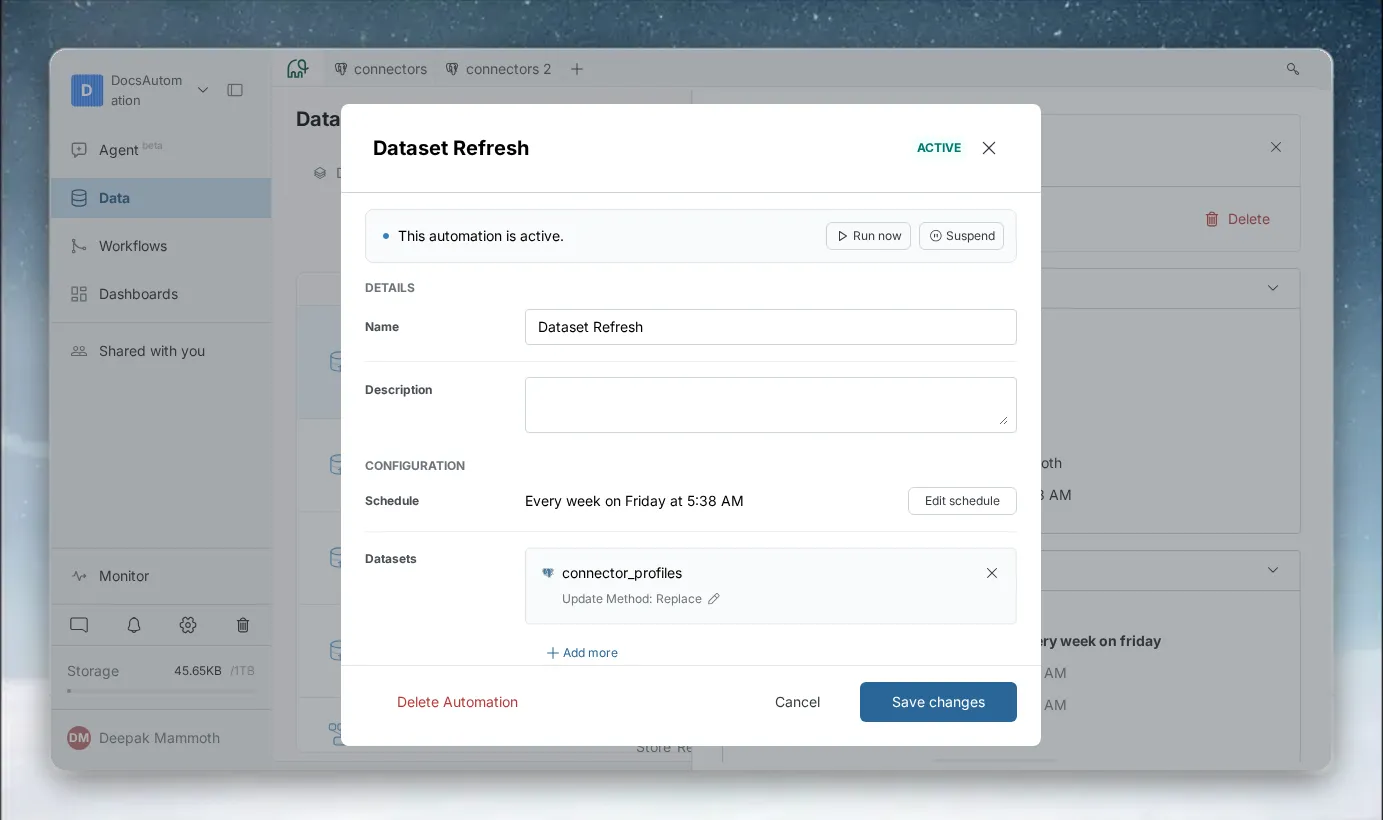
You can't change an automation's type. Under CONFIGURATION you can change:
| Type | What you can change |
|---|---|
| Dataset Refresh | Datasets, schedule, start and end dates, order and update methods |
| Data Consolidation | Source folder, name pattern and Include subfolders, destination dataset and its update and mapping settings |
| Scheduled Export | The exports it runs, schedule |
| Messaging | Schedule, recipients, subject, message body, attached Views |
| File Collection | Sources, destination folder, schedule |
To change a schedule, click Edit schedule in the Schedule row. Click Save changes. You see "Automation edited successfully!" Changes take effect from the next scheduled run, so use Run now to test a new configuration straight away.
See who changed an automation
Click ⋯ on the row, then View activity. The automation's activity opens in a dialog (titled, for example, Activity: Daily sales), so you can see who changed it and when. See Activity log.
Delete an automation
- In the detail panel, click Delete (shown in red).
- In the ⋯ menu, click Delete.
- In the edit window, click Delete Automation.
The Move to Trash? dialog says the automation "will be moved to Trash and automatically deleted in 30 days unless restored" (30 days is the default; the dialog shows your workspace's Trash period), and "You can restore it any time before the deletion date from the Trash section." Click Move to Trash to confirm. See Get things back from Trash.
Fix an automation that shows Error
- Open the detail panel.
- Read Last run result. It shows the specific error.
- Check the common causes:
- a dataset, View or folder it uses was deleted;
- a cloud connection expired (Dataset Refresh);
- an attached View was deleted (Messaging).
- Edit the automation to fix the cause.
- Use Run now to check the fix.
A file whose columns don't match a Data Consolidation's destination doesn't put the automation in Error. It shows Files not added instead. See Fix files a watched folder didn't add.
Troubleshooting
| Symptom | Cause | Fix |
|---|---|---|
| "You don't have access to Automations" | Your project role doesn't include viewing automations | Ask a Project Admin for access |
| Run now is greyed out | The automation is Suspended | Resume it, then click Run now |
| The Items in Trash dialog opens when you resume | A dataset or View the automation uses is in Trash | Click Restore items and resume |
| You can't move a dataset or View to Trash | An active automation uses it | Remove it from the automation, or suspend the automation, first |
Related
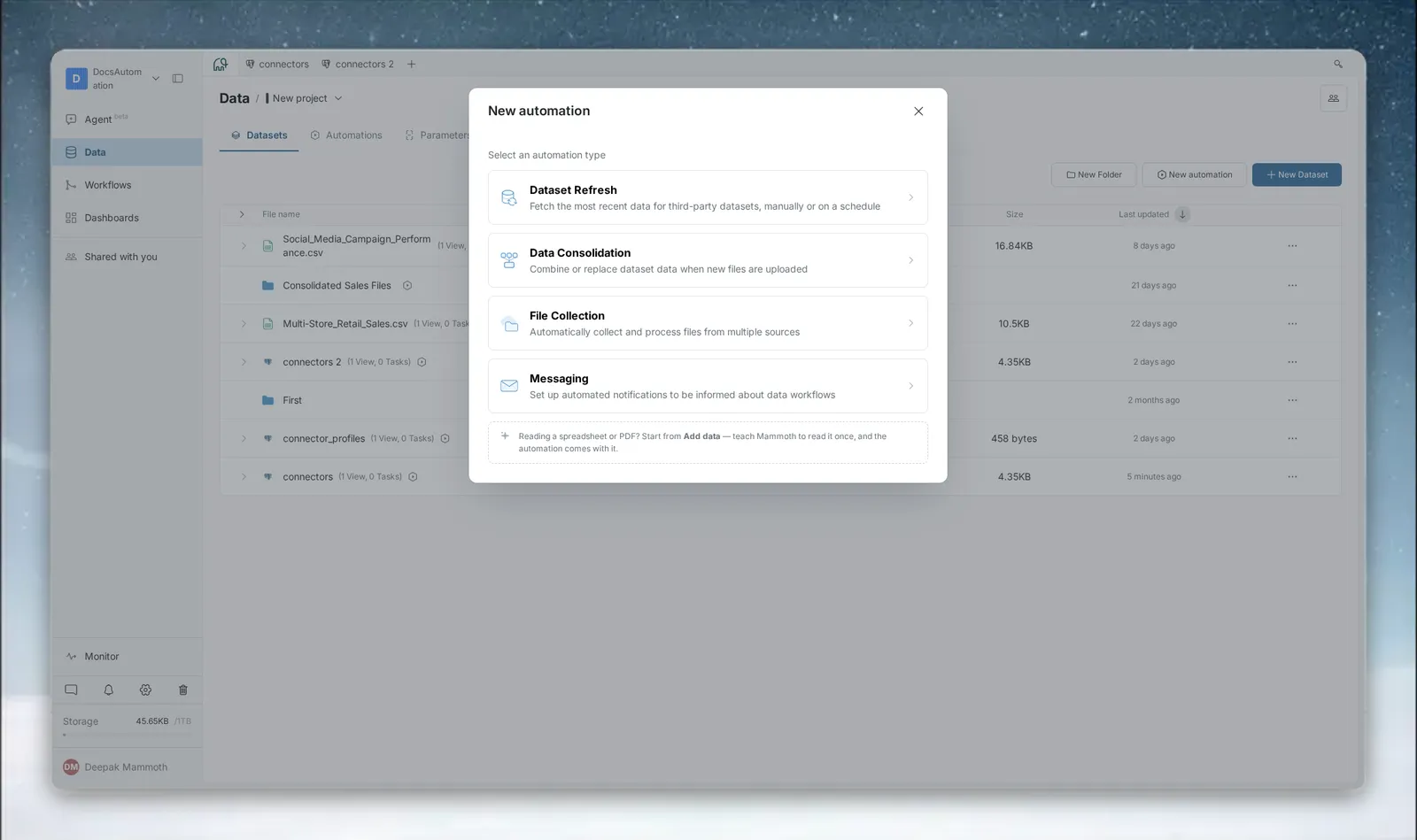
- Create an automation: set up a new one.
- Schedules and triggers: change when it runs, or run it through the API.
- Combine incoming data: fix files that didn't go in.
- Monitor running and failing work: see every running automation in the project.
- Activity log: find who changed an automation.
Something wrong? support@mammoth.io